



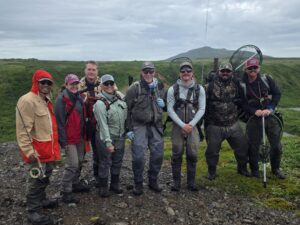
 Tenkara fishing is slowly gaining more acceptance in the fly-fishing arena but it’s still a very small niche within the industry. While more fly anglers are finally giving it a try, you’ll still only find one or two tenkara anglers along the most popular rivers in the heat of a season – if that. We are the vast minority and can often be made to feel unwelcomed or unwanted in fly shops and on guided fishing trips. So, when I find a place or people that welcome me and my tenkara fishing, I return:
Alaska is not really my home but after 9 consecutive years of annual trips to King Salmon, it has a familiarity and comfortable feel about it, similar to home. Returning to a place you recognize – the rooms and bar stools, the bends in the rivers, the gravel islands and rock formations but mostly and critically, the people. Dan and Amy Herrig are the owners of Rapids Camp Lodge in Bristol Bay, Alaska West Tent lodge on the Kanektok River, Andros South on South in the Bahamas and Rio Salvaje Lodge, a small fly fishing and eco-expedition lodge, in Southern Chile. Combined they form Deneki Outdoors, a group of lodges strategically placed offering some of the world’s finest remote fisheries.
The lodges are casual and comfortable and provide the absolute best guiding by the best guides in the world. They know you’re there to fish and work hard to support your success whether through their daily flyout program, jetting you up and down a river or hiking to a special spot. Deneki staffs their lodges with passionate guides who make it happen for you. But its more than that.
I have fished locally and internationally with a number of guide services, outfitter and lodges that shutter when you mention tenkara. They immediately fluff you off, spout their reluctance and skepticism and essentially predict, it won’t work. When they assign guides, nobody wants the “tenkara dude” and they pull straws to avoid getting stuck with you. With a deep sigh and eye roll, they often put you on the back burner and try to avoid interactions. Mostly because they actually know nothing about the method except for some preconceived, prejudicated, limited idea of it – what it can and cannot do and the assumed skill set of the angler using it. I have gotten used to it.
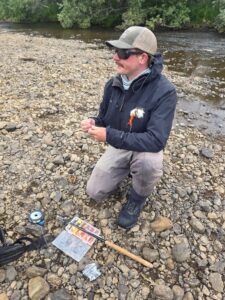
Alaska fly fishing guide setting up a Zen Tenkara rod with egg pattern
However, Rapids Camp Lodge is different. It’s always been different and that’s why it feels like home. From the very beginning, RCL guides were curious and interested in learning. They admitted not knowing anything about tenkara but, they wanted to learn. I’ll never forget my first trip to the lodge. At the bar while waiting for what I would come to anticipate as a spectacular dinner, guides gathered around and wanted to check out the rods I brought. We went out to the courtyard and all wanted a turn casting them. We walked down to their dock where the float planes were tied up and cast until the dinner bell rang multiple times. We had fun, we laughed, and they were all asking questions. No one criticized or rolled their eyes. No one made dismissive comments. All the guides were eager to fish with the “tenkara lady” throughout the week. They all funneled through not only guiding me but also fishing the rods and learning how to set them up. That curiosity and acceptance went along way.
Over the nine years fishing at Rapids Camp Lodge, I’ve landed tons of magnificent rainbows, char, Dolly Varden and grayling. We’ve slammed sockeyes on the Zen Sagi with the guide having to hold onto my wader belt to keep me from getting wet. I cast a hundred casts hoping to get a Coho/Silver Salmon on the Zen Kyojin until one finally grabbed, and then another…and another. It was a tremendous fight, but we landed them. Chum salmon, some fresh from the ocean and sparkling silver, other partially through their spawning journey, colors changed from silver to purple stripes – we’ve landed them by the dozen. Pike? Sure, I said. Let’s give it a go and together we figured it out using a tenkara rod. Each trip, each outing, each species has been an adventure filled with fun and learning. That’s what great guides and lodges deliver.
If you ever book a trip with a guide who is less than thrilled that you want to fish tenkara, be patient. Remind yourself it’s probably due to their lack of knowledge and self-confidence with the method. Remember, the guide is supposed to be the authority. Assure them that with a combined effort – their knowledge of the water and fish, and your knowledge of tenkara, the day can be fun and a success. It’ll push them out of their comfort zone and can be an opportunity for them to learn (in case they ever guide another tenkara angler in the future) and for the two of you, to figure things out together.
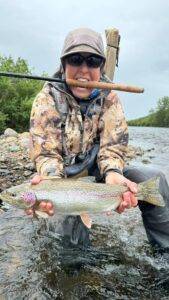
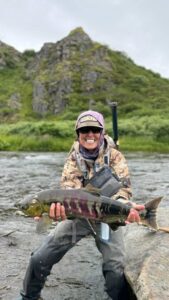
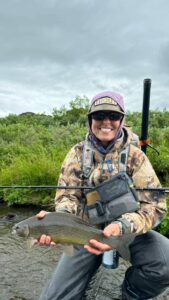
You may not be heading to Alaska any time soon but find those guides, those outfitters and lodges, wherever you go, that are curious and supportive, that want to learn and will help you succeed and make you feel at home, when fishing tenkara.
Hi there! I’m new in fish lure making. Can you give me some ideas of the most effective tenkara patterns you use for fishing? I will greatly appreciate if you send me some pictures or patterns for tenkara fly. Again I telling you that I’m new but but I’m eager to learn. I think there’s nothing to be ashamed to ask somebody who really know better about tenkara fishing.
Hi Mary Grace
Thanks for connecting and welcome to the world of tenkara and fly fishing. Never be ashamed of asking a question – that’s how we learn! Asking a question just means you’re brave because you’re willing to put yourself out there. Tenkara fishing is simple, so don’t make it complicated. In traditional tenkara its less about picking the “right” fly pattern and more about what you do with it. Traditional tenkara flies are very simply and don’t really resemble a true insect. Instead, they have a simple shape but are tied with a reverse hackle which creates movement and action in the water and “brings the fly to life”. The simplest is a Sakasa Kebari which is available on our website (I can’t post a picture in this response). They consist of a simple, thin “body” and hackle tied so that is faced toward the hook eye. By simply tapping your tenkara rod gently, this pattern will “pulse” when in the water current. It is also a very easy pattern to learn to tie if you want to make your own flies. But, let me be clear, you do not have to use tenkara flies on a tenkara rod. You also use regular fly-fishing fly patterns from dry flies like a elk hair caddis, to terrestrials like a grasshopper or Chernobyl Ant pattern, to nymphs such as a pheasant tail or bubble back emerger and even steamer patterns like wooly buggers. Simply put, there is no limit to the type of fly patterns you can use on a tenkara rod.
Please feel free to reach out with any other questions you may have. We are always happy to help and support other anglers.