



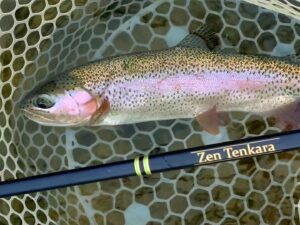
Tenkara rods are available in different flexes. From a slow and deep 5:5 flex bend to a fast action tip-only 8:2 flex bend, one or the other isn’t better or worse, they’re just different and are either more or less effective depending on the fishing scenario. Knowing the benefits of different action rods is important so you can choose the right tool for whatever task you have at hand.
In the regular fly-fishing world, saltwater fly-fishing rods are most frequently fast action rods. Why do manufacturers build fast action saltwater rods and why do saltwater anglers prefer them? It’s because in saltwater fly fishing anglers are very often dealing with wind. They may also be using larger and heavier fly patterns, and they usually required to cast greater distances resulting in them carrying more line. More line means more weight. Finally, saltwater flyfishing commonly involves sight fishing. So not only is distance required but accuracy is too. Faster rods are more proficient at delivering all these things particularly in windy conditions. Now let talk tenkara.
Faster Rods:
A fast action tenkara rod, just like a fast action regular fly rod, will be able to punch through wind more effectively than a slow rod. It will also be able to cast larger and/or heavier fly patterns and cast them more accurately. There is less of a chance for distortion or rotation in a fast action rod blank than a slow one that bends willingly and freely. And because a fast action rod requires a greater amount of force to bend and flex it (in other words, load it), a fast action tenkara rod can also carry more line easier. While most tenkara anglers are casting short distances, there is a growing number of anglers, especially warm water tenkara anglers, who are casting longer lines for greater distances. A faster action rod can make this effortless.
When it comes to hook sets and fish management a faster action tenkara rod can be quite helpful. Very soft tenkara tips can make hookset more challenging. The tip will flex deeply under pressure from the fish which can result in moments of slack in the line and give a fish the opportunity to throw a hook. Getting and keeping solid hook sets require slightly more “Oomph” on a softer rod.
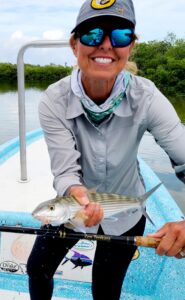
Fish management can be a tricky thing on a tenkara rod. Obviously, you can’t allow the fish to fish, but you also don’t want to overpower a fish or rip lips. Balance is important. You need a tenkara rod with enough flex to cushion the pressure placed on a fish – especially larger or more powerful fish. But too much flex or too soft of a rod and you have no control to steer or direct it. Further, a ton of flex and bending can also mean uneven tension on the line or bouncing, which again creates moments of slack in the line and gives a fish another opportunity to throw the hook. Tenkara rods that flex and provide some “cushion” to the fight is good, but a stiffer rod will provide the angler with more control on bigger fish and ultimately more stopping power, (or at least holding power).
Softer Rods:
Softer tenkara rods, just like softer regular fly rods have their place and purpose. Mostly these slow action, unhurried rods are best suited for smaller fish that don’t require much force or power to control. They are best suited for smaller, lighter fly patterns and setups that lack weight. And soft tenkara rods are best matched for short, light lines. These slo-mo rods can deliver delicate, airy casts that carry your fly softly onto the water. Which is why they are best fished in more protects waters away from strong winds and gusts that can bend a soft rod even before moving it and make casting difficult. With light fly patterns and short lines and casts, distortion and rotation are less of an issue, even on deep flexing or noodly rods. So accurately can still be precise since distance isn’t involved.
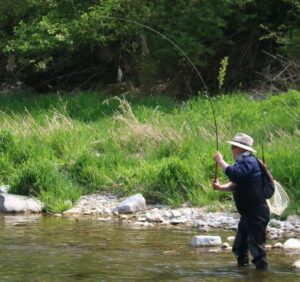
Slow and fast action rods both have their place in any complete tenkara arsenal. Each have their benefits and can be highly effective given that they are used in their proper or intended fishing scenario. You wouldn’t grab a 3wt fly rod to go chase steelhead. You wouldn’t grab a Gumby bamboo rod to fish them either. Rather you’d want a rod with some backbone and power in the midsection and maybe a faster tip section for solid, fast and furious hook sets. No different in the tenkara world. Understanding tenkara rod characteristic will ensure that when you reach for a rod, you grab the best one for the job at hand. The right rod in hand will increase your chances of success, will protect a fish from drawn-out, overextended battles and land the fish more efficiently.